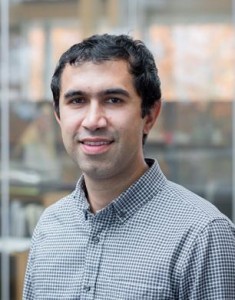
Professor
BASc (Tehran, Iran), MASc and PhD (Waterloo)
Office: KAIS 4042
Phone: (604) 827-4269
Fax: (604) 822-5949
Email: peymans@ece.ubc.ca
Peyman Servati is a Professor in the Department of Electrical and Computer Engineering at UBC. He is leading The Flexible Electronics and Energy Lab (FEEL) and Centre for Flexible Electronics and Textiles (CFET) and is a member of Clean Energy Research Centre (CERC) and Microsystems and Nanotechnology (MiNa) Research Group of UBC. His research interests are low-cost and flexible solar cells, flexible transistors and electronics, growth and synthesis of semiconductor nanowires (NWs) and nanocomposites, electronic device modeling and engineering, and novel device engineering for medical and energy applications.
Dr. Servati received his PhD and MASc from the Electrical and Computer Engineering Department of the University of Waterloo, in 2004 and 2000, respectively, and BASc from the University of Tehran, Iran, in 1998. Before joining UBC, he was a Research Associate at the Centre for Advanced Photonics and Electronics (CAPE), University of Cambridge working on nanowire growth and device engineering. Before joining the University of Cambridge in 2005, he was a Senior Research Scientist with Ignis Innovation Inc., a spin-off company of the University of Waterloo working on novel glass and plastic displays.
Dr. Servati is the winner of 2006 NSERC Canada-UK Millennium Research Award and 2005 NSERC Doctoral Prize, and the 2004 University of Waterloo Outstanding Achievement in Graduate Studies Honour. He has more than 80 publications in peer-reviewed journals and conferences, 4 patents and 10 patent applications, and 3 book chapters. He is the co-winner of the 2002/03 IEE Institution Premium for the Best Paper in Circuits, Devices, and Systems, and the winner of Bronze Medal in the XXV International Physics Olympiad (I.Ph.O.), Beijing, China, 1994. Dr. Servati is the regional editor for IEEE Electron Device Newsletter and the Chair of Displays Subcommittee for IEEE Photonics 2011.
Research Interests
Smart textile and wearable technology, flexible electronics, flexible solar cells and batteries, advanced nanomaterials
Research Areas
Research Groups
- Biomedical and Multimedia Signal Processing
- Electrical and Computer Engineering in Medicine
- Flexible Electronics and Energy Lab (FEEL)
- Microsystems and Nanotechnology (MiNa)
Teaching
- Electrical Engineering Seminar and Special Problems – NANO RENEW ENERGY
- ELEC 315 – Electronic Materials and Devices
- ELEC 543 – Green Nanotechnology Devices
- CPEN 523 – Software Project Management