Advanced Science cover features paper from ECE’s Kenichi Takahata and team

Advanced Science cover features paper from ECE’s Kenichi Takahata and team

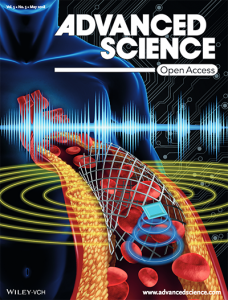
Advanced Science, May 2018 issue

The cover for the May 2018 issue of Advanced Science features a research paper written by Associate Professor Kenichi Takahata and his team consisting of Xing Chen, Babak Assadsangabi and Professor York Hsiang (a vascular surgeon at Vancouver General Hospital and UBC Faculty of Medicine). The paper is titled Enabling Angioplasty‐Ready “Smart” Stents to Detect In‐Stent Restenosis and Occlusion.

The featured paper discusses an intelligent version of a stent, a vascular implant, enabled by Micro-Electro-Mechanical Systems (MEMS) and radiofrequency technology that monitors and gives a warning of the most critical problem caused by the implant known as restenosis (narrowing or occlusion of arteries), which often occurs post implantation and can put patient lives at risk.

“This work has demonstrated the first intelligent stent that is compatible with today’s interventional procedure and tools and has shown wireless tracking of local blood flow via in vivo testing,” explains Dr. Takahata. “This is a breakthrough step that will promote the clinical and commercial application of smart stent technology.”

Advance Science is a renowned open-access journal with a high impact factor that covers a broad range of research areas in science and engineering, including life science and healthcare studies and applications.

Read the cover paper and check out the full May 2018 issue.

Francisco Paz aims to close the loop on student learning

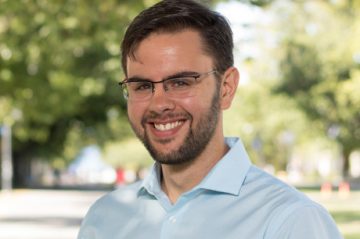
Francisco “Pancho” Paz

Francisco “Pancho” Paz, a PhD student in the Department of Electrical and Computer Engineering at UBC, recently received a Killam Graduate Teaching Assistant Award recognizing his outstanding work as a Teaching Assistant and instructor for 2017/2018. The award is awarded annually to 16 UBC Teaching Assistants.

Pancho, who is committed to acadamia, is grateful for the countless opportunities to give back and contribute to post-secondary education. He is humbled by the recognition and credits the people around him for his success.

“I’m going to be honest, I never feel like I’m a good teacher,” says Pancho. “I felt very honoured to receive the award because a huge part of this comes from the recommendation of my supervisor, instructors, colleagues and students.”

Pancho continues to learn and grow from his teaching experiences in order to be a more effective educator. He draws inspiration from teachers that he’s had in the past.

“When I think of past instructors and what stands out the most, they were people who were really passionate and would transmit their work in a meaningful and interesting way,” reflects Pancho. “What makes instructors great is when they care for the student and have a passion for the process of teaching and what they’re teaching.”

Dr. Martin Ordonez, Pancho’s supervisor for the past six years, nominated him for the award and continues to be impressed by his patience and ability to communicate complex concepts to students. It’s clear to him that students and colleagues enjoy working with Pancho.

“Pancho is a leader and role model for other teaching assistants,” says Dr. Ordonez. “He develops strong connections with students and establishes a comfortable, stressless learning environment where students can feel safe to ask questions and are both encouraged and motivated.”

Pancho believes in the importance of putting yourself outside of your comfort zone to learn and grow. As a scholar at the Liu Institute for Global Issues, he is able to collaborate with people from other disciplines. He finds that the biggest challenge is communicating and understanding different ways of thinking.

“The whole social sciences framework is different from natural sciences, which can be very dry as we want to communicate in the most succinct way possible,” explains Paz. “It can be hard to collaborate and find common ground when you come from different backgrounds, but it’s a fantastic opportunity for me to work with people from areas outside of engineering.”

Despite having spent most of his life in academics, Pancho still wakes up excited to go to work everyday. In addition to teaching duties, he is working on research that focuses on power electronics and renewable energy. He’s on the path to graduate at the end of the year and is open to working in the industry, but Paz believes his true calling is in academia.

“I really love teaching and research, so the role of the academic professor will be what I look for first after graduating.”
ECE team wins Distinguished Paper Award at ICST 2018

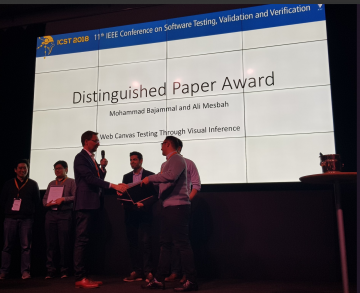
ECE PhD student Mohammad Bajammal and his advisor Ali Mesbah won a Distinguished Paper Award at the 11th IEEE International Conference on Software Testing, Validation and Verification (ICST 2018).

Their research paper titled Web Canvas Testing through Visual Inference was selected by the ICST committee as one of the top three papers among the 30 papers accepted this year for publication from a total of 119 submissions. The paper made advancements that enable software engineers to automatically analyze and test graphics-intensive web apps, such as medical, geographical, and educational apps, through visual analysis, a task that could not be effectively accomplished before.

ICST is the premier annual international conference on software testing and provides “a common forum for researchers, scientists, engineers and practitioners throughout the world to present their latest research findings, ideas, developments and applications in the area of Software Testing, Verification and Validation.” The conference took place in Västerås, Sweden from April 9 to April 13 this year.

ECE alumna awarded NSERC postdoctoral fellowship

Saba Alimadadi

Saba Alimadadi, a UBC Electrical and Computer Engineering (ECE) PhD graduate, has been awarded an NSERC Postdoctoral Fellowship to help support her work in analysis of asynchronous behaviour of modern applications. She ranked first in the CS division of the competition.

According to NSERC Canada, “the Postdoctoral Fellowships (PDF) Program provides support to a core of the most promising researchers at a pivotal time in their careers. The fellowships are also intended to secure a supply of highly qualified Canadians with leading edge scientific and research skills for Canadian industry, government and universities.”

During her time at UBC, Saba was supervised by Dr. Ali Mesbah and Dr. Karthik Pattabiraman and was member of SALT Lab. In her dissertation, Saba proposed automated techniques for facilitating comprehension, helping developers understand the dynamic behaviour and motifs of program execution. Results showed that her methods significantly improve the performance of developers in their everyday tasks.

Program comprehension is crucial in software engineering; a necessary step for performing many tasks. However, the implicit and intricate relations between program entities hinder comprehension of program behaviour and change. It is particularly a difficult endeavour to understand dynamic and modern programming languages such as JavaScript, which has grown to be among the most popular languages.

She is currently a postdoctoral researcher at Northeastern University, working on an analysis of asynchronous behaviours of modern applications. Saba is determined to continue her academic career, and the prestigious NSERC PDF is a great help and encouragement for achieving her goals.

Congratulations Saba!

ECE team runner up for Siemens Young Investigator Award at SPIE Medical Imaging 2018 conference

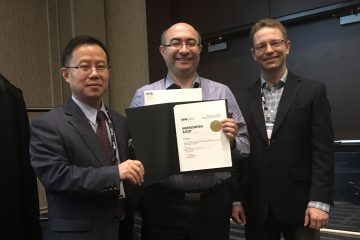
ECE professor Purang Abolmaesumi accepting the runner up prize for the Siemens Young Investigator Award at SPIE Medical Imaging 2018 conference.

ECE professor Purang Abolmaesumi accepting the runner up prize for the Siemens Young Investigator Award at SPIE Medical Imaging 2018 conference.

Shekoofeh Azizi, PhD candidate in the Department of Electrical and Computer Engineering, postdoctoral fellow, Sharareh Bayat, along with Ajay Rajaram were recipients of the runner up prize for the Siemens Young Investigator Award at SPIE Medical Imaging 2018 conference in Houston, Texas. The conference took place from February 10, 2018 to February 15, 2018.

Their paper and presentation is titled 3D Tissue Mimicking Biophantoms for Ultrasound Imaging: Bioprinting and Image Analysis

Azizi’s supervisor, Purang Abolmaesumi, presented and accepted the award on their behalf. Their work was a collaboration with Aspect Technologies.

Congratulations on this achievement!